Poor
Sax.
If it’s not one thing, it’s another.
Although of a fishy assertion,
it was the candid-criminality declared
having sampled the stomach contents of her member striped-sisters by a team of researchers,
who documented the lengthwise measurement in centimeters of ingested Atlantic
Menhaden and recorded such ranges of sampled entrée sizes in order to scientifically-estimate
and mathematically-support by posits of probability and calculable principles
of standard deviation, a determination that her species, Morone Saxatilis, was found to feast primarily on a mean length of forage fish (Menhaden, appropriately, in this instance) that is
of 8.4
cm (3.3
in) in length. What’s more, examined forage
fish stomach samples ranged strictly from
2.5 cm (1 in) to 19.5 cm (7.5 in) in length.
I
chanced upon this “unbiased report” in a social media news feed of a well-known
grassroots organization that crusades for the defense of Atlantic Menhaden
conservation through public interest lobbying for harvest reduction, whereby curiously
clicking further, I learned of and then read in its esteemed entirety, a recently-published
(03/27/2017)
study’s 11-page
analyses detailing forage fisheries findings entitled “When Does Fishing Forage Species Affect Their Predators?” (Hilborn,
R., et al., Fish. Res. 2017, http://dx.doi.org/10.1016/j.fishres.2017.01.008). Then I followed the bouncing (bait) ball.
The published abstract of the article reads as follows:
“This
paper explores the impact of fishing low trophic level “forage” species on
higher trophic level marine predators including other fish, birds and marine
mammals. We show that existing analyses using trophic models have generally
ignored a number of important factors including (1) the high level of natural
variability of forage fish, (2) the weak relationship between forage fish
spawning stock size and recruitment and the role of environmental productivity
regimes, (3) the size distribution of forage fish, their predators and
subsequent size selective predation (4) the changes in spatial distribution of
the forage fish as it influences the reproductive success of predators. We show
that taking account of these factors generally tends to make the impact of
fishing forage fish on their predators less than estimated from trophic models.
We also explore the empirical relationship between forage fish abundance and
predator abundance for a range of U.S. fisheries and show that there is
little evidence for a strong connection between forage fish abundance and the
rate of change in the abundance of their predators. We suggest that any
evaluation of harvest policies for forage fish needs to include these issues,
and that models tailored for individual species and ecosystems are needed to
guide fisheries management policy.”
The
article misleadingly advances the following “findings”:
-
Predator rate of increase is uncorrelated with forage fish abundance.
-
Forage species are affected much more by environmental conditions than by
fishing.
-Previous analysis of forage fish impacts on
predators ignored natural variability.
-
Spatial distribution of forage species may be more important than their
abundance.
-
Predators often take small forage fish that are unaffected by fishing.
Paragraphs of great interest, by estimation of my analytical readership
and sensible opinion, are as follows:
“Local
density can either amplify natural variability in food supply, or the predators
may be able to concentrate on high density locations even at low prey
abundance, thus buffering them from the fluctuations in total abundance.
Despite the importance of local forage abundance for central place foragers,
there is little evidence relating abundance of forage species to the abundance
of mobile predators. Jensen et al. (2012) cited several of the studies showing
the importance of local abundance to central place foragers but also reviewed
the empirical literature relating marine predatory fish abundance to abundance
of their prey and found few clear links apart from a decline in cod
productivity following the collapse of both herring and capelin in the Barents
Sea.”
- pg. 2 –
“Some
marine predators consume forage fish at sizes and ages before the fishery
harvests them. This is most true for predatory fish and marine birds, where
mouth gape sizes limit the maximum size of prey that can be eaten, and probably
least true for marine mammals. As an example, Nelson et al. (2006) showed that
the mean size of Atlantic Menhaden (Brevoortia Tyrannus) eaten by Striped Bass
(Morone Saxatilis) in Massachusetts was 8.4 cm, but the mean size taken by the
fishery was 28 cm. In the extreme, if the recruitment of forage fish is not
affected by fishing, and the predators consume sizes smaller than taken by the
fishery, then the fishery would have no impact on the food available to the
predator. In other words, the fishery harvests only those individuals that have
survived and grown large enough to escape most of their predators.”
- pg. 2 -
“Our
analysis of the relationship between predator rate of change and abundance of
individual prey species suggests little evidence for strong connections. This
is likely due to the many factors discussed above that mediate the link between
fishing, prey abundance, spatial distribution and size, and predator population
dynamics. The fact that few of the predator populations evaluated in this study
have been decreasing under existing fishing policies suggests that current
harvest strategies do not threaten the predators and there is no pressing need
for more conservative management of forage fish.”
- pg. 10 -
“It
must be remembered that small pelagic fish stocks are a highly important part
of the human food supply, providing not only calories and protein, but
micronutrients, both through direct human consumption and the use of small
pelagics as food in aquaculture. Some of the largest potential increases in
capture fisheries production would be possible by fishing low trophic levels
much harder than currently. While fishing low trophic levels harder may reduce
the abundance of higher level predators, that cost should be weighed against
the environmental cost of increasing food production in other ways. Fish
provide food without substantial use of freshwater, fertilizer, antibiotics and
soil erosion. Forage fish also have among the lowest carbon footprints of any
form of protein production. Thus it is not clear that from a global
environmental perspective that reductions in fishing mortality rates on forage
fish would necessarily be precautionary.”
- pg. 10 -
If you catch my drift, I’m sure you’ll agree that something
smells like dead fish. A red herring,
to be exact. Simply read between the
lines and you’ll just as easily conclude how the striper’s striped-lines are
those being tested by the hands of businessman-kind’s insatiable willingness
for rapacious consumption of the Atlantic’s profitable mossy-backed biomass once
again, only this time with outlandish claims that forage fish (Menhaden) over a
certain length are definitively, 100%
outside the scope of Striped Bass predation, but worse still, suggesting that
there exists a direct, environmental benefit linked to lessening the effects of
climate change by increasing the
harvest limits of forage fishes, thereby mitigating the carbon footprint
realized at the expenditure of alternative (land-based) food productions of
protein.
Foremost,
this article failed to mention what sized
Striped Bass were those
identified and measured by its researchers that supported the claims of their
findings. This is very important, (crucial, perhaps) and would be directly-correlated
to the measured results of their “findings.”
I doubt many, if any, were
those breeder-sized bass of the type which terrorize and deliberately inhale adult
Menhaden without reserve. Mossbunker forage
fish of lengths greater than 7.5 in. (think May & June Bunker blitz-fishing
along the Jersey Shore). Clearly,
this study smells pungently of Omega-3
fatty acid fish oils and as an academic cover for the colossal-sized,
commercial Menhaden-reduction fishery. To
postulate that Striped Bass only consume a forage fish diet specifically and scientifically-determined
in length is as preposterous as claiming that an adult elephant will only eat the
same quantity of food as when its diet was studied as a baby elephant, even though
maturation developed it into a fifteen-thousand pound animal. Simply put, in this case, as the predator
grows, as does its choice (and opportunities thereof) of forage fish diet for
consumption. What fits into the manhole-sized
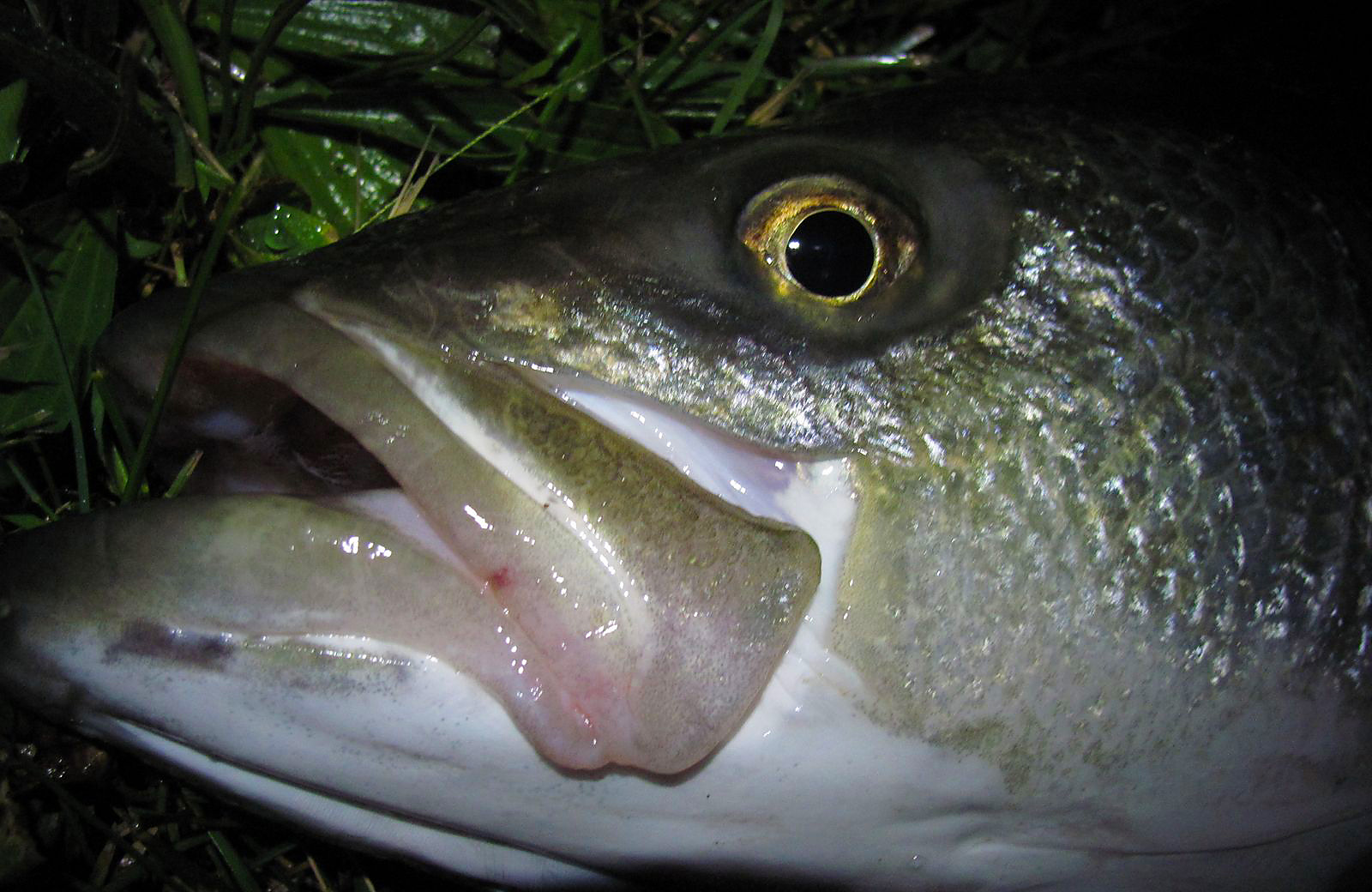
gape of a Striper becomes her next meal.
It’s that simple. Given the natural
opportunity for the biomass of Striped Bass to mature in size, weight, and
length, this becomes an observable reality.
Just ask a seasoned Striper fisherman.
As
scientifically-accurate the methodologies of data collection and recognition of
recorded observations for this study may have been, by simply reading the report, anyone would
consider there to be blatant, abundantly-sufficient
evidence for objection of its findings in that clearly-discounted, or conveniently-ignored, are a number of real-world
truisms. Those which are completely skewed in favor of commercial
fishing’s future harvest initiative or potential claim (enter, Omega Protein). Simply refer to the paragraphs of interest
and bulleted findings that I have documented earlier in this writing. The words all speak for themselves.
Above
all else, how can the suggestion whereby removing
a food-source (i.e. Menhaden longer
than 7.5
in.) from the coastal Atlantic at an annual harvest rate of 180,000+
metric tons (Omega Protein’s 2016 allotted
quota) not have a consequence on dependent
forage feeders and the dietary behaviors of upper-trophic level species? Remember, an indisputable tenant of the
Menhaden’s lifecycle is that adult fish must first breed in order to populate the Atlantic with scaly, mossy-backed
scions of “3.3 in. mean-sized”
forage fish the study claims that predators known as Striped Bass so prefer (or
rather, were studied to only consume). It’s blasphemy
to suggest that adult Menhaden should
be harvested at an increased quota as their size alone excludes them from
natural, upper trophic-level predation. Instead, there
needs to exist in the wild, in inshore quantities large enough, such an adult
biomass of forage fish that linesider predators can consume (and perhaps be documented in a study as
having consumed of), because it’s a fact they will, when such forage fish are present in schools like the ones tightly-formed
to the ocean’s surface with fins and tails nervously flipping. It’s that simple. Follow the bouncing (bait) ball.
“Humankind
has not woven the web of life. We are
but one thread within it. Whatever we do
to the web, we do to ourselves. All
things are bound together. All things
connect.”
- Native American tribesman, Chief Seattle -
 |
The "red herring" smear campaign funded by the National Coalition for Fishing Communities, of which, Omega Protein is a prominent business member.
|
 |
| "Predators (Striped Bass, in this case) generally target small forage fish that are unaffected by fishing" claims the study. Right, unaffected...... |
 |
| Social media post. |
 |
The F/V Rappahannock was christened on May 18, 2013 at Omega Protein’s Reedville, VA facility. She is a 196' state-of-the-art menhaden fishing vessel prized among their fleet of 11 ships.
|
 |
The
184' F/V Fleeton was also christened on May 18, 2013 at Omega Protein’s
Reedville, VA facility by Anna Scholtes, wife of Omega Protein CEO,
Bret Scholtes. “These two vessels allow us to harvest menhaden in a
more efficient and environmentally conscious capacity. It also allows us
to better preserve those fish and conduct our operations in a safer
way. It’s really a win-win scenario in all regards," Omega Protein CEO
Bret Scholtes.
|
 |
| In one strand of the "web of life," it washes-up along the sandy shores of our beaches as Stripers feasting on Menhaden. |