Showing posts with label Utah. Show all posts

Saturday, June 29, 2019

Damn, You Don't Say

Last April, I first explored under dusty footstep and swam eyesight across oceanic, bluebird-sky the breathtaking geological surrounds of beauty that are Utah’s national parks.  Vistas of topographies, each exposed as stratified rust-colored rocks in the formations of walls, windows, pinnacles, buttes, canyons, narrows, arches, massifs, mesas, spires, bridges, and bends silently and sublimely compose this ancient, desert-like landscape.  At the time, and much to my added surprise, there also existed one particular fusiform form of strata I was much more familiar with viewing – stripes.  I learned that a transplanted tribe of Striped Bass school the vast, freshwater depths of a dammed, man-made section of the Colorado River I had visited named Lake Powell.  A piece I wrote of this experience and published to A Multitude of Fins can be read here

This April, at 11:15AM on the second day of the month, on the second day of Heather Litke’s shared fishing excursion of the San Juan River arm of Lake Powell with her husband Ryan, a tautness of exact timing and place suddenly struck out of the clear-blue morning like lightning, electrifying the length of a precariously-deepening arc of eyelets to strain waterward against the startled backbone of a rod quivering of pulse.  Pulling from fathoms below, unbeknownst in the moment, was none other than the freshwater leviathan of a freshwater fisher’s lifetime.  This sinking surge of fighting-fin being only countered in runaway measure at the fulcrum of her clenched hands grasping and working of their serendipitous favor.  An especially weighty resistance of gaining absorption and excitement ensued.  Then, by 11:30AM that morning, a new Utah state record surfaced its gleaming, 44½ inch, 35.33 lb. broadside body painted of seven laterally-running stripes from the drinking-water depths of intrigue to the revelatory exposure of a triumphant sunlight casting sharpest of shadow overhead.  With one hook-set, one watertight queen of the whitewater achieved notoriety as the largest documented catch & release fish captured in the recorded history of the state.  What’s more, she was just ½-inch-shy of the state’s longstanding 48.7 lb. record rockfish specimen landed in 1991 of this same lake’s waters. 

What’s perhaps greatest, it that this genetic wonder she admirably watched come to reanimate with life from the hold of her encouraging revival grip, disappearing downward after a sinuous kick-starting send-off and sweeping rake of broom tail into the depths of Powell, could someday resurface even appreciatively larger and longer.  In essence, Heather has generously entrusted all who cast this reservoir next with her prized, living trophy.  A record-setting and reigning fish of legend for yet some other fortunate freshwater angler’s hoist of honor and inestimable approval of smile.  May Litke's record stand as solid as the rockfish's corralling walls of surrounding red rock, but for all one knows, some angler, with any luck of luring, may some day lean to this lake's waterline to release the lengthened-of-stripe, swimming benefaction of her once-released catch. 


“The charm of fishing is that it is the pursuit of what is elusive but attainable, a perpetual series of occasions for hope”  -  John Buchan


“You fish, in essence, for surprise out of nowhere, for an instant in which you suddenly become aware that you’re attached to a heartbeat.”  -  Ted Leeson


The above photo and following caption was posted to the Utah Division of Wildlife Resources social media account page on May 23rd: "RECORD FISH: Remember the massive striped bass Heather Litke caught earlier this spring? It was just certified as Utah's newest catch-and-release record. At 44.5 inches, this Lake Powell striper was the catch of a lifetime. Congrats, Heather!

Friday, June 29, 2018

Dam, You Don't Say


The curl of crashing whitewater tumbling and breaking onto a shoreline was nowhere to be recognized through the soaring survey of his gawking gaze gainfully panning over the petrified landscape.  Nor even faintly audible or listened, a rhythmic, cavernous rumble or sharp, slapping crackle produced of splintering surf or collapsing wave set.  So it seemed, that two time zones and thousands of westward miles away rather, while perched atop the rust-colored and geologically-youngest stratum of Navajo Sandstone capping the three-hundred-million-year-old strata of the Colorado Plateau, inching a pair of desert-dusted trail sneakers closest to a vertiginous canyon rim, where hundreds of feet below spread the serpentine and smooth, sapphire-colored skin to the second largest man-made reservoir in the country, Striped Bass were at long last, the last longing thought on his vacationing mind. 
How damn surprising, he would later conceive, having learned from one page chance turned upon in a Department of Wildlife Resources fishing guidebook, that schooling far below and somewhere between his many-miles-wide vista of corralling red rock, swam none other than the revered rockfish. That below the visibly characteristic lines and stark sedimentary layers of strata spanning laterally above a waterline, longer grew the characteristic strata of stripes and lateral lines of the linesider below that waterline.  That mirrored under a panoramic, bluebird-ceiling emptied over Powell, so foraged a transplanted tribe of bass in the reticent imitation of blue below.  That at the actual transcontinental “Crossroads of the West,” in of all places, the Beehive State, before the freshwater chasm of a hydroelectric-generating segment of the carving Colorado River, he would unintentionally gravitate nearest to the top inshore saltwater game fish of his native East Coast, while sightseeing on the West Coast.  That within an artificial lake risen from a desiccated desert, equally as artificial would be the concept of casting plastic, trebled artificials here for a championed saltwater fish.  So however damn convinced, he would imagine, if even by her natural nature as the watertight queen of the whitewater, as the physiologically anadromous M. saxatilis, that it certainly was dammed-surprising she could conceivably lurk and fin as closely as the reach of a loaded rod’s hope aimed and hurled aerially from shore.
Yet it was completely true.  Out there, within a lake’s shoreline framed of vertically-rising igneous and metamorphic rock risen from the basement of time, far below the stippled surround of vegetative varieties of blackbrush and shadscale rooted far below the call of the California Gull circling above, a shrieking stimulus instinctively alarming any number of prehistoric-looking lizards looking skyward to scurry for shelter over the terrain’s recognizably reddish scattered sand, so swims the recognized state fish of Maryland, Rhode Island, and South Carolina.  Out there, below the widening wakes of passing pontoon boat keels and captaining revelers, listens the celebrated state saltwater fish of New York, New Jersey, Virginia, and New Hampshire to the muffled drone of outboards slicing open the film of a reservoir’s still surface above.  Water, that is of the same river running seaward through the breath-taking Grand Canyon, hundreds, and at serpentine sections, thousands of feet below rims it carved over millions of flowing years.  The same river that is renowned for its native cutthroat, rainbow, brown, brook, and lake trout, large and small mouth bass, bluegill, crappie, and catfish.  The species of fish one would immediately and naturally picture as the prized, prismatic-patterned obsession of a western fly fisherman’s forward-reaching front cast fallen over freestone.  The same reservoir of a river whose headwater is La Poudre Pass Lake on the western side of the Continental Divide, 10,174 ft. above sea level in the snow-capped Rockies.  Yet here, in arid heat, downstream of white-water rapids and upstream of neon Las Vegas, is a non-tidal body of water duly credited in surfacing an angling record rockfish in 1991 weighing 48.7 lbs.  From tip to tail, the freshwater leviathan measured 45 inches in lucky, landlocked-length. 
Perhaps the outright irony of my discovery was simply a short leap of faith away anyway.  Across the vista of water, buttressing both ends of a concrete dam, lay the spirit of a timeless, desert secret.  A secret geologically-written for those inclined to imaginatively interpret from the lining reservoir rock’s striped-strata of iron-y rusty-red colors seeping in plain sight at Sax’s surrounding shoreline.  Truth be told, the iron-y color to this strange story of piscatorial coincidence is painted by none other than the master herself – Mother Nature.  Here, Her medium of choice and identifiably characteristic technique is evidenced in the inherent oxidization of these rocks specifically-rich in the iron-oxide mineral hematite; the specific reaction of which hemorrhages all the U.S. Southwest of its red and coppery colors.
  In this land of water-carved canyons, havens honored by national park names such as Bryce and Zion, of this ancient topography carved of massive, gravity-defying stone arches and magnificent horseshoe bends, testaments of eroding-time itself, however rock-solid, sacred, and still, it nevertheless assures a surf fisherman from New Jersey to readily admit that if these remarkable rocks couldn’t adopt the viridescent color palette of a rockfish, they at least offer humble homage in their growth of distinct and characteristic stripes.  And for a striper fisherman, I find that to be rock-solid enough.  How dam reassuring, that in a state named Utah, Striped Bass swim the depths of drinking water, in what is more ironically, the fish’s adopted homewater.


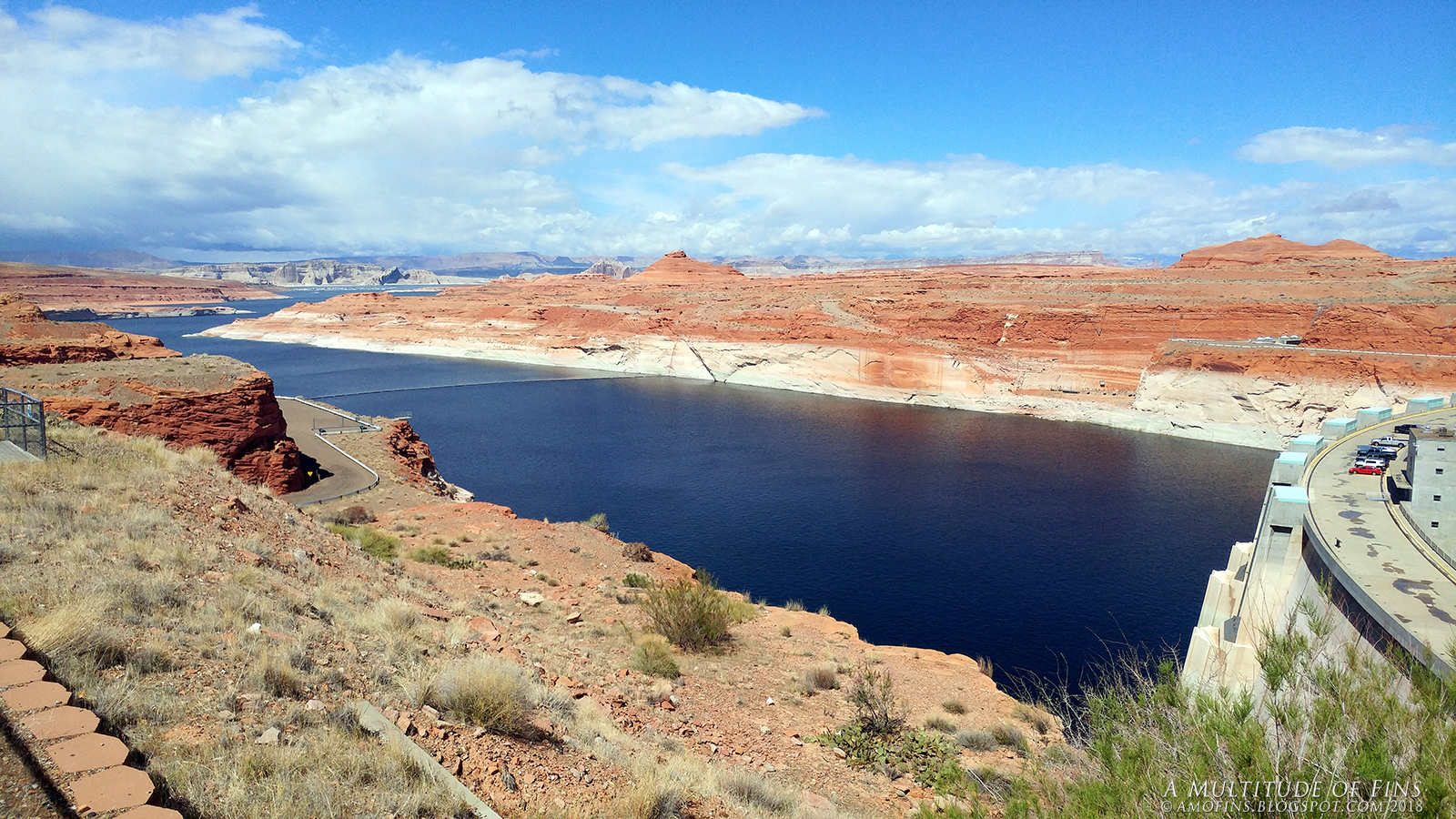
The geographically southern-most point of the Lake Powell reservoir as seen from the Glen Canyon Dam.  This body of water encompasses 1,900 miles of shoreline over Utah and Arizona, with an average measured depth of 132 ft and maximum depth of 583 ft. 


Completed in Sept. 1963, The Glen Canyon Dam towers 710 ft. in height and spans 1,560 ft. end-to-end.


The anadromous M. Sax. as seen on page 58 of the fishing guidebook I thumbed while in Utah.


“All there is to thinking,” he said, “is seeing something noticeable which makes you see something you weren't noticing which makes you see something that isn't even visible.” - Norman Maclean.